First seen in Washington City Paper
Dispensary owners say razor-thin margins and an oversaturated market leave little room to absorb Mayor Bowser’s proposed 70 percent sales tax increase.
The District’s medical cannabis market is Mayor Muriel Bowser’s latest target as she tries to patch a $1 billion-plus tax revenue shortfall in this year’s budget proposal.
No other businesses are looking at an increase in sales taxes in the fiscal year 2027 budget, but D.C.’s medical cannabis industry faces a more than 70 percent increase, which business owners say could be the “last straw” for stores trying to survive in an oversaturated market. Retailers already must overcome high fees and taxes as well as competition from Maryland’s adult use market.
A spokesperson for the Office of the Deputy Mayor for Planning & Economic Development tells City Paper via email that the mayor’s office projects a general fund contribution of more than $1.5 million in fiscal year 2027 and $6.3 million over the entire plan from the tax increase. The tax increase is intended to align the medical cannabis rate with off-premise alcohol.
The money would be directed to support “core services such as healthcare and education,” the DMPED spokesperson says. But medical cannabis business owners believe the tax could burden an already struggling market.
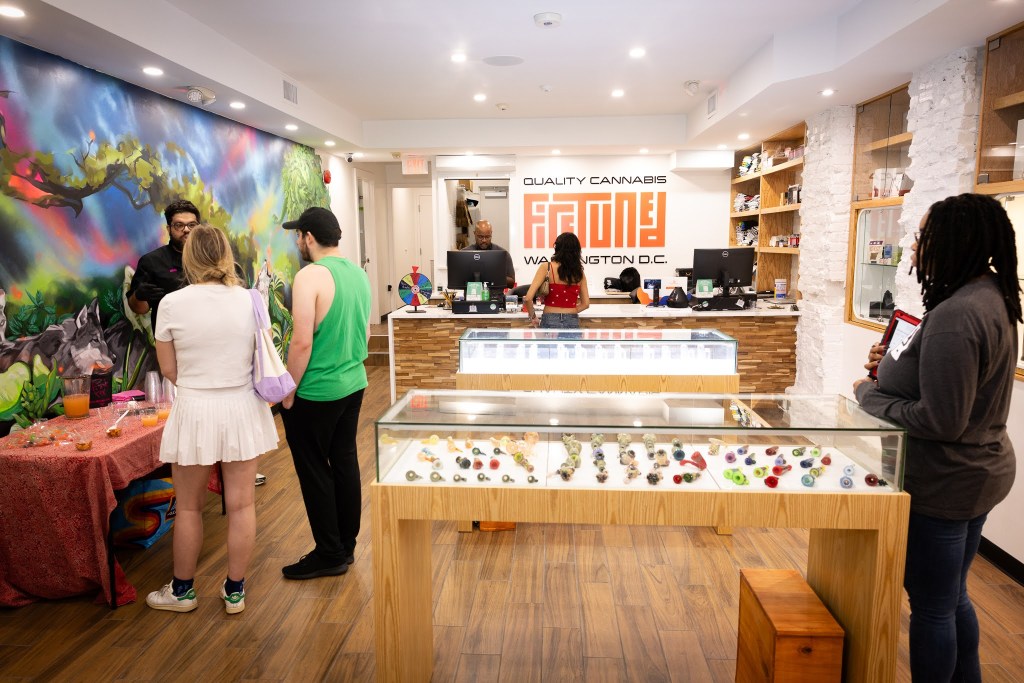
“That would be catastrophic because people already don’t like to pay the taxes. And then they already complain about D.C. prices because it is steep already,” says Danila Bradley, the co-owner of Firetuned, a medical dispensary in Dupont Circle that opened in fall 2025. Her store has struggled to survive since opening, but she says it’s finally seeing consistent customer growth—growth she worries a tax hike would undo.
Bradley says higher taxes would not just hit operators but patients directly, potentially pushing them toward cheaper, unregulated sources, including lingering “gifting” operators that still function in the city’s gray market.
The budget report from Council’s Committee of the Whole, released on May 22, echoes that concern, warning that “an increase in the sales tax may incentivize District residents to turn to illicit sources that will undoubtedly be cheaper.” It adds that a reduction in patients would ultimately lead to a decline in overall market sales and, paradoxically, lower tax revenue.
The report also raises broader worries about the structure of the proposal, stating “grave concerns” about the impacts on the medical market and that removing the increase “should be a Council-wide priority.” The committee further warns that a tax increase could “stifle sales at a time when the District needs to see continued growth in the industry in order for businesses to survive.”
Those warnings come as D.C.’s cannabis market continues to expand rapidly—but unevenly.
Over the past four years, D.C.’s medical cannabis industry underwent a massive expansion following years of domination by unlicensed “gifting” stores that operated in a legal gray zone. While voters legalized adult-use cannabis in 2014, the District has still not been able to implement a full recreational market due to a federal spending rider.
The Medical Cannabis Amendment Act of 2022 opened new licenses, allowed “gifting” cannabis stores to transition to the medical market, and made it easier for patients to sign up for medical cards. Over the past two years, more than 100 unlicensed “gifting” shops have been shut down or pushed underground. Many still operate without storefronts.
But market growth has failed to keep pace with the rapid expansion of dispensaries.
Although D.C.’s medical cannabis program recorded more than $6.5 million in retail sales in April 2026—the highest monthly retail sales total in program history since the first dispensary opened in 2016—average revenue per dispensary has continued to fall since March 2025, when the number of stores operating in the city more than doubled.
The District now has roughly 5.4 times more dispensaries per capita than Maryland, creating an increasingly saturated retail landscape as operators compete for a limited customer base. The average revenue per dispensary in D.C. is less than $100,000 per month.
At the same time, Maryland’s adult-use market continues to siphon off potential customers, offering cannabis access without requiring patients to enroll in a medical program.
The committee report highlights the higher tax burden of cannabis businesses, 80 percent more than other businesses, due to restrictions on what they are allowed to deduct. “This high tax burden means that most medical cannabis businesses in the District are barely able to survive,” the report states.
Operators say the policy mismatch is compounded by the lack of reinvestment back into the industry. The proposed tax increase comes after a social equity fund meant to provide assistance to new licensees was already axed in 2024.
“Currently, there is no mechanism through which revenue generated by the cannabis industry is reinvested in the cannabis industry,” says Jordan K. Johnson, the general manager of Firetuned. “That is entirely unacceptable. You don’t reach in people’s pockets without helping them out.”
That frustration is compounded by the timing: Owners say the market is far too unstable to absorb a tax increase right now.
“Taxing a nascent market that is trying to get its feet together—it’s on precarious ground already—is probably not the best long term policy,” Johannes Cassidy-Seyoum, the CEO of High Demand, a nearly year-old medical retailer on Capitol Hill, says. The committee’s report reflects the same concern saying that a tax increase could “stifle sales at a time when the District needs to see continued growth in the industry in order for businesses to survive.”
Cassidy-Seyoum also believes that the sales tax increase would hit his most vulnerable customers, especially given the current state of the economy. (D.C. currently has one of the highest unemployment rates in the nation.)
“There’s a huge swath of customers that are extremely [price] sensitive that rely on cannabis for daily medicinal use,” Cassidy-Seyoum says. High Demand already offers a 30 percent discount to terminal patients to help remove barriers to access.
“It’s just sad that you know the government would be working in the opposite direction,” he says.
According to Cassidy-Seyoum, D.C.’s lower sales tax is one of the few legs up it has over Maryland. “To wipe that out would leave us with even fewer advantages.”
Grace Hyde, the vice president of manufacturing at District Cannabis, a cultivator and manufacturer in D.C. approaching almost a decade of business, says the tax could result in “unsustainable” retail business.
“The margins are so razor-thin and people are just getting by. This could really push the industry over the edge,” she says. District Cannabis opened its own retail store two years ago. “If there’s a tax increase, that would definitely impact our wholesale business, because it’s just going to result in less sales overall in the District. It’s going to hurt everyone, so there’s no win,” Hyde adds.
The D.C. council has the opportunity to suggest changes to the Mayor’s budget. It will be voted on with amendments by the council on June 9.

