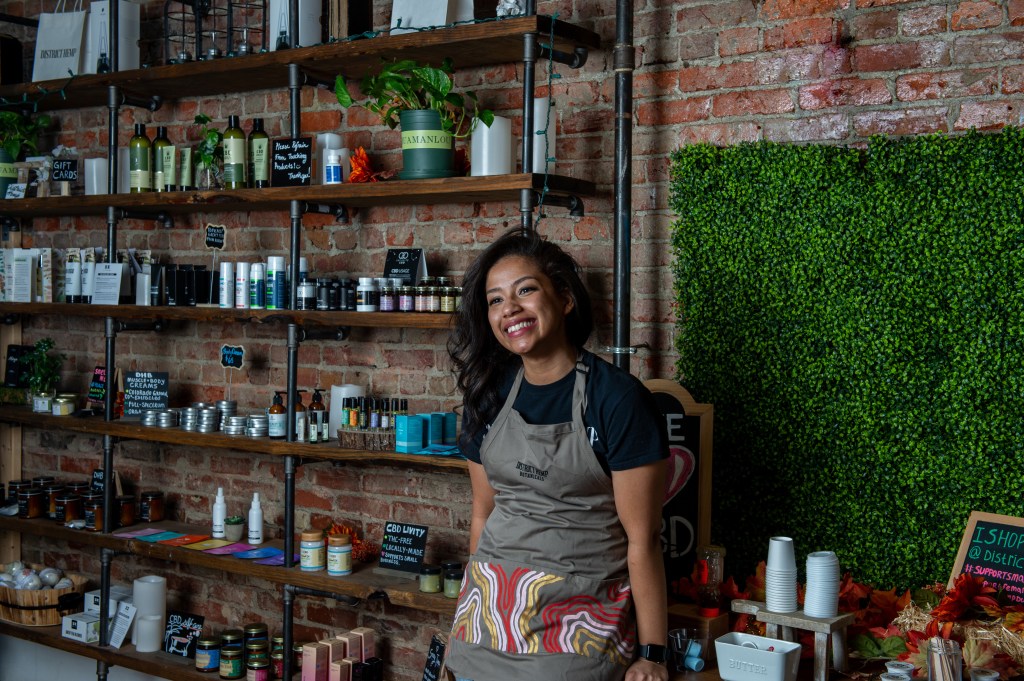
The Alcoholic Beverage and Cannabis Administration shuttered two hemp retailers Thursday, raising questions about the city’s authority to regulate the product that’s federally legal—for now.
First seen in Washington City Paper.
The Alcoholic Beverage and Cannabis Board shut down two major hemp retailers in the District on Thursday—enforcement actions that one owner called a “sideswipe.”
In 2022, when D.C. expanded its medical cannabis program, ABCA began shutting down the so-called “I-71” gifting market, named for Initiative 71 that legalized recreational cannabis use. Gifting shops sold non-cannabis products such as shirts and poems that came with gifts of cannabis products sourced from the illegal market. Hemp retailers in the city maintained that they sold federally legal products, but many faced the same enforcement as cannabis gifting shops.
Cannabis contains higher levels of THC, the intoxicating compound of weed, while hemp is a variation of cannabis cultivated for industrial uses like oil and fiber. The low levels of THC in hemp are not enough to get a person high.
The Farm Bill passed by Congress in 2018 legalized hemp products with a THC concentrate under 0.3 percent. The hemp industry in the U.S. has grown into an industry that produces about $28 billion in annual revenue, but D.C. hemp retailers have faced uncertainty about the legality of selling hemp in the District. They maintain that they are abiding by federal law, but D.C. has maintained since 2021 that any hemp sold in D.C. must be sold within the legal medical cannabis program.
“We were getting very mixed signals from the city as to what was legal and acceptable and what wasn’t,” says Barbara Biddle, the owner of District Hemp Botanicals, one of the stores that was closed down on Thursday by ABCA with the help of Metropolitan Police Department officers. She runs two additional hemp businesses in Virginia and sells products that are produced in Virginia and other states, such as Colorado, that have hemp regulatory frameworks and testing. Her products, including hemp flower and hemp derived topicals, are nonintoxicating or contain low doses of THC. Her D.C. store celebrated its eight-year anniversary this past October.
Biddle faced fines from the D.C. Department of Licensing and Consumer Protection in 2024 after an earlier ABCA enforcement visit, but all fines were dropped by the city that same year after she sued. “We thought that we were past all that and that we were on a path forward. But this caught us by surprise,” she says, referring to the store closure and arrest of one of her employees. It’s unclear if law enforcement officers seized any of Biddle’s product, but they have done so in previous closures.
Biddle says that all of her store’s products are federally legal. City Paper reviewed lab testing results for her products that showed they are below the federal legal limit. But ABCA’s summary action report for the closure of District Hemp Botanicals cites three undercover purchases of loose cannabis flower and a preroll joint that tested over 0.3 percent delta-9 THC within the past month.
“I have lab tests for every product I carry,” Biddle says. “I’m very meticulous about it, and so for them to say that my products tested hot like that is absolutely not the case. We are very diligent about this with our vendors.”
“I am not ever intending to break the law. We stay in the hemp segment, and we’re very clear about being a hemp company,” she adds.
ABCA’s summary action report for Flowerz, the second shop closed on Thursday, listed three undercover purchases of prerolls and cannabis flower within the past month. The report details positive THC tests with “levels significantly above 0.3% delta‑9 THC.”
Chad Frey, the owner of Flowerz, responded to City Paper’s request for comment via text: “We had a visit from ABCA and Metro PD today regarding hemp regulations. We are cooperating fully and remain confident in our compliance. The store is currently closed, and management is handling all communication.”
ABCA has shut down more than 60 illegal cannabis operations in the District since the fall of 2024. The medical cannabis market has expanded to more than 50 legal dispensaries in the past year, and the District has seen record revenue and patient registration since the expansion of the medical program. But individual dispensaries are struggling to make a profit. D.C. is not allowed to set up an adult-use recreational cannabis market despite voters’ approval. A congressional budget rider has prevented D.C. from creating a recreational market since 2015.
There is a pending lawsuit against the District by another hemp retailer, Capitol Hemp, addressing its “lack of statutory authority to regulate hemp.” The next hearing is in early January. Capitol Hemp was not closed on Thursday. And other retailers that carry hemp products, such as Whole Foods, have not been shut down.
Many states, including Alabama and Ohio, have passed laws this year banning intoxicating hemp products that are still technically legal under federal law. A recent provision in the fiscal year 2026 federal funding bill that ended the government shutdown closed the Farm Bill loophole and will make hemp illegal. This change will not go into effect until November next year.
Before Thursday, Biddle was focused on lobbying to amend the federal law before it impacts her business. But now she is primarily focused on helping her employee who was arrested Thursday during the closure and charged with selling marijuana. Biddle says she’s hoping to raise money to cover her employee’s legal costs and lost wages.
“It’s horrible. The first thing that comes to mind is my employee. Like, how dare they?” Biddle says. “None of us are intending to break the law, and instead of just communicating with us, they give us criminal charges. That is unacceptable.”
Biddle says that despite ABCA’s public position, she had the impression that they were willing to work with her.
“There needs to be clear laws. I don’t want to have to go to court to fight this to prove my innocence,” Biddle says.

