First seen in Washington City Paper
Some have been arrested, others are making a fraction of what they were earning in the gray market.
D.C.’s unique cannabis market drew Nat Alexander all the way from Kentucky in 2021. She moved to take a job at one of the popular brick-and-mortar cannabis shops that covered the city. The “gifting” stores had been operating in a gray market, using a legal loophole that followed Initiative 71’s passage in 2014. The law allowed adults to possess small amounts of cannabis and gift it to others without the exchange of money.
A recreational retail market, where the D.C. government could tax and regulate cannabis, was explicitly prohibited due to a congressional budget rider. But business models developed across the city where stores sold other products such as key chains or stickers that came with gifted amounts of unregulated cannabis products.
Alexander thrived at her job, rising from a budtender to a product manager in three and half years. And she made a comfortable salary even for D.C., a city with one of the highest costs of living in the country. She prided herself on the high quality of unregulated products, like organic flower and cold water hash, she was able to source. “We were improving the lives of people with the things we were able to bring in,” she says.
But that all came to an abrupt end last fall when the store where she worked was forced to fire most of its employees due to revenue loss as it transitioned into the legal medical cannabis market. Alexander’s store was one of more than 200 gifting shops that was given an ultimatum when the D.C. Council passed the Medical Cannabis Amendment Act of 2022: transition to the medical legal market or close.
As a result, employees of the I-71 cannabis gifting shops have faced job loss and, in some cases, arrest while working retail shifts in the once-thriving gray market. These employees now face poor job prospects and major pay cuts as some of them transition to work for the legal medical cannabis market.
Only 45—less than a quarter—of D.C.’s gifting stores successfully transitioned to the legal medical market as of April 2025, leaving potentially hundreds of employees out of work. Even the stores that did transition, like Alexander’s, were often forced to cut staff due to the significant revenue drop after leaving the unregulated market.
The city’s Alcoholic Beverage and Cannabis Administration, which regulates cannabis in D.C., reports that, as of April 14, almost 50 shops were padlocked—where the city’s cannabis enforcement task force actually changes the locks on the shops’ doors. The last day that any gifting shop could operate in the city, according to ABCA enforcement rules, was March 31, 2025. (Gifting between individuals is still legal.)
Since the first raids on unlicensed gifting shops, 20 people have been arrested by the Metropolitan Police Department, which has assisted ABCA in its enforcement actions. Many of the arrests were related to carrying unlicensed firearms, but almost a half dozen were related to charges of possession with attempt to distribute cannabis. A few cases have been dropped, but others are still being prosecuted or were resolved with guilty pleas.
Alexander was never arrested and says she was able to land on her feet after losing her job due to “pure luck and timing.” She found a new position in the legal medical industry, but she says it came with a nearly 50 percent pay cut. She says she’s watched more experienced colleagues completely give up searching for employment.
“My quality of living is cut in half,” she says.

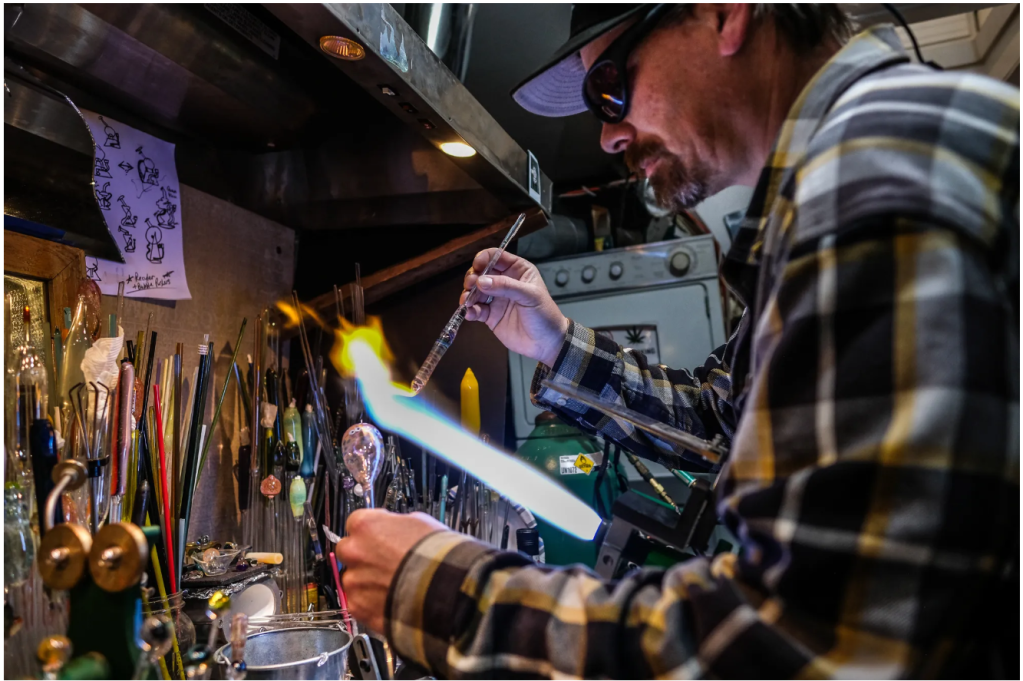
Drue Downs, a D.C. glass artist who has been part of the gifting market since 2017, also managed to land on his feet with a position at a new legal shop. But he is seeing the entire industry crumble around him.
“A lot of friends I know that work in the cannabis business or are in the cannabis industry are struggling to survive,” Downs says. One budtender position he applied for (like bartenders but for weed) drew 700 applicants. “People went from riches to rags.”
Downs is aware of gifting shop owners who were forced to close their businesses after receiving cease and desist orders from ABCA and are now working as employees in other cannabis shops. He says the rest of the gifting community members he knows have either lost everything they built, are struggling to keep their businesses afloat, or have transitioned to a legal medical business but are barely breaking even.
His glass art business, where he makes bongs and other glass smoking accessories, also took a hit. He went from years of bringing in more than $100,000 in revenue to barely breaking $25,000 in 2024. Virginia’s allowance of homegrown cannabis and the 2023 legalization of adult-use cannabis in Maryland gave consumers more options and pulled them away from D.C.’s gifting and medical markets. The city didn’t formally try to put an end to the cannabis gifting market until 2024.
The current struggle is a stark contrast to the heyday of D.C.’s cannabis gifting market, when unregulated pop-ups proliferated across the city and underground cannabis entrepreneurs from across the country flocked to the District to push their brands. To Downs, the peak was from 2017 to 2020 before the pandemic put an end to many of the cannabis events. “It was magical. It was like Amsterdam probably was in the ’90s,” he says.
The loss of employment and economic opportunity is compounded by the cultural loss. A.D., who asked to be identified by their initials out of fear of retaliation for working in the gray market, saw the loss firsthand. The Adams Morgan store they managed closed last year after it refused to transition to the medical market.
“People that worked in the I-71 shops were in the D.C. arts scene. They are the D.C. arts scene,” A.D. says, referring to the cannabis gifting economy as “lifeline” for local artists. Their store hosted community parties and acted as a hub for musicians and artists to host events.
“The I-71 scene being stripped and taken away is probably like one of the saddest things that’s happened in the city in a long time,” A.D. says. They were one of almost a dozen other employees who lost their jobs when the Adams Morgan store closed in the winter of 2024. They say most of their co-workers are still searching for jobs months later.
When A.D. first started working at their gifting store, it provided a quality of life none of their other service industry or retail jobs offered. “I had peace of mind,” they say. “I had my shift. I came to work. I was able to pay my rent. I was able to take vacations. I was able to pay for a car. These are all things I have trouble doing now.”
A.D. can no longer afford a medically necessary inhaler, and they have gone from working five days a week at one job to seven days a week at three jobs. And still, they only make half of their previous salary.
To A.D., it feels as if the majority of gifting stores are being punished for a few bad actors, who exist in every industry.
“It’s just much easier for people to believe that the bad actors in this industry were much more rampant than they were because most of this industry was Black,” A.D. says. “For the entire time that you did have those bad actors, [the city] could have done anything, anything to make sure their shops weren’t existing, and it didn’t.”
In a handful of shops, out of the hundreds that once operated in the city, police have found other, illegal drugs, such as meth and cocaine. And, in 2024, an employee at a now-shuttered gifting shop on Georgia Avenue NW was shot and killed during a robbery.
Despite the transition period offered by ABCA to incentivize gifting stores to turn medical, A.D. sees the changeover to the medical cannabis market as a “corporate” takeover. A.D. would have preferred to see the Council pass legislation that better regulated the gifting industry, rather than force it to transition to medical.

The move also prompted skepticism among the gifting market community, Downs says. “Unfortunately, people don’t trust the government,” he says. “So I think a lot of people thought it was a trap.”
He is hopeful for the future of D.C.’s legal market, but the 45-year-old has been around long enough to watch other promising markets crash in Colorado and California. Whether D.C. is on track for a similar fate is up in the air as the medical market gets up and running at full steam.
“A lot of my friends say the time has come and gone. But I think cannabis will always be part of life, culture, and medicine,” Downs says. “It’s just [a matter of] how it is integrated.”
 LJ Dawson